Germany
Podcasts
Heimat Revisited: Jeremy DeWaal on Place, Belonging and Post-war Politics in West Germany
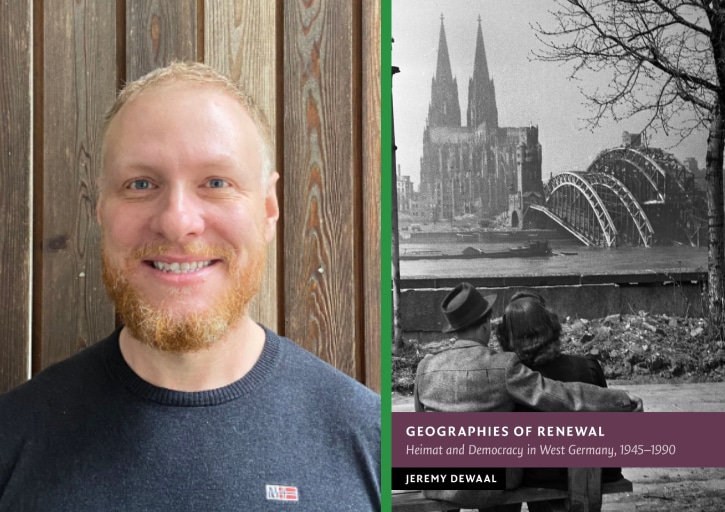
What does it mean to feel “at home” in a place, and why does that matter for democracy? In this episode, historian Jeremy DeWaal talks about Heimat, a German word that is famously hard to translate. It is often rendered as “home” or “homeland”, but it also points to a deeper sense of belonging, memory and emotional attachment to specific places.
22.01.2026
Interviews
A Fragile Constitution? – In Conversation with Dieter Grimm
On March 25, 2025, the “new” German Bundestag began its work. While the government will likely consist of the familiar coalition of Social and Christian Democrats, it may face unprecedented challenges. In the new composition of the German parliament, the center parties no longer hold the two-thirds majority required to amend the German constitution—the Grundgesetz. After, in the “old” Bundestag, a parliamentary motion was adopted for the first time since the fall of the Nazi regime, only due to the support of the far right; some commentators have gone so far as to declare the end of the German political center. Shortly thereafter, the far right achieved record polling numbers in the federal elections. These circumstances raise the question of whether the German legal system is resilient enough to withstand periods of political instability. While the German Constitution is widely regarded as a success, some argue that it has primarily functioned as a “Schönwetter-Verfassung”—a [...]
27.03.2025

News
Quo Vadis, Deutschland? – Political Realignment
For decades, post-war German politics has rested on a shared commitment to keeping extremist parties at the margins. The principle of the cordon sanitaire — a firewall between democratic and anti-democratic forces — was more than a procedural rule; it became a moral and institutional cornerstone of liberal democracy in Germany. But what happens when this line begins to blur? We asked our contributors: How likely is the cordon sanitaire to collapse in the next parliament? And what unconventional forms of cooperation or tactical maneuvering might emerge across the political spectrum in the upcoming legislative cycle?
21.03.2025

News
Quo Vadis, Deutschland? – The Future of Multiculturalism
This mini-series brings together leading scholars working in and on Germany to offer their insights into the key questions arising from this pivotal moment of transition. Through a multi-angled, interdisciplinary discussion, it examines the political, economic, and social forces driving change and shaping the country’s and the broader region’s future. In this second edition, our contributors examine the shifting dynamics of integration and diversity in Germany.
14.03.2025

News
Quo Vadis, Deutschland? – The Future of the Socio-Economic Model
Germany’s latest parliamentary elections mark more than just a change in government — they signal a potential turning point for the country’s economy, multicultural identity, and political landscape. As the European Union’s largest and most influential member grapples with mounting domestic and global pressures, the decisions made in the coming years will not only define Germany’s trajectory but also reverberate across Europe and beyond.
11.03.2025
News
German Election Brings Some Relief but Huge Challenges Lie Ahead
After the dust settled on election day and the sun rose over the Hauptstadt one thing became abundantly clear: the outcome could have been far worse. The terror attacks in Solingen, Mannheim, Magdeburg, Aschaffenburg and Munich made asylum and immigration the top electoral issue, forcing the two governing left-wing parties (the SPD and Greens) to play defense, and compelling conservative leader Friedrich Merz to launch a law-and-order offensive focused on the securitization of borders. While the maneuver prevented the far-right Alternative for Germany (AfD) – which had been calling for similar measures since 2015 – from taking ownership of the issue, it also led Merz’s Christian Democrats (CDU) to pass a non-binding parliamentary resolution together with the far-right.
25.02.2025

News
Red Flags and Writings on the Wall? Rising Threats to Democracy on Both Sides of the Atlantic
Donald Trump has been re-elected in the United States, and Germany is preparing for snap elections in February 2025. Both countries are likely to face political changes as they are witnessing the rise of anti-establishment movements. How resilient is democracy in Germany and the United States? Should we worry?
3.12.2024

The Curse of the Margin? Central Europe before and after Communism
In conversation with RevDem assistant editor Lucie Hunter, Dr. Aliaksei Kazharski discusses his newest book Central Europe Thirty Years after the Fall of Communism: A Return to the Margin? (Rowman & Littlefield, 2022, 2022).
26.05.2023

Emancipating Jews from Narratives of Victimhood and Redemption: Susan Neiman Discusses Germany’s Current Memory Culture
In this conversation with RevDem editor Ferenc Laczó, Susan Neiman dissects what has made the articulation of universalistic Jewish commitments increasingly difficult in the German public sphere; explores why debates concerning global colonialism and the Nazi-colonial connection tend to be so fraught in the country; explains what post-colonial criticisms misunderstand about the intellectual heritage of the Enlightenment; and shows how both ignorance regarding Eastern Europe and social solidarity with the victims have shaped German responses to the ongoing Russian war of aggression against Ukraine.
2.12.2022

Caroline Mezger: Youth and the Politicization of Germanness in Interwar Yugoslavia
A conversation with Caroline Mezger about her book, "Forging Germans: Youth, Nation and the National Socialist Mobilization of Ethnic Germans in Yugoslavia (1918-1944)."
18.03.2022

