European Union
Podcasts
Holding Frontex Accountable – In Conversation with Joyce De Coninck
In current public discourse, human rights violations at the EU’s borders are inextricably linked to one specific actor: the European Border and Coast Guard Agency – or, in short, Frontex. Since its establishment in 2004, human rights activists have become increasingly aware of various rights violations committed by the agency, particularly in the Mediterranean. To name just one example, Frontex has been accused of providing the locations of migrants intercepted at sea to the Libyan coast guard, which then transported them to camps where they have been systematically raped, tortured, and enslaved. Remarkably, despite accusations of the most severe human rights violations, Frontex has largely managed to avoid legal consequences. Currently, Frontex stands before the Grand Chamber of the Court of Justice of the EU for the first time in its history.
11.08.2025

News
What is Union Citizenship For?
With its judgment in Case C-181/23, the Court of Justice of the European Union (CJEU) has put an end to a long-standing debate: Malta’s citizenship-by-investment scheme is incompatible with EU law because it violates the “bond of solidarity and good faith” between the individual and the member state that Union citizenship requires. In her op-ed, Anja Bossow examines the potential implications of this new criterion—both its perils and its potential promise.
21.05.2025

Podcasts
The Untold Story of Schengen: A Conversation with Isaac Stanley-Becker
In this episode of the RevDem podcast, investigative journalist and historian Isaac Stanley-Becker discusses his revealing new book, Europe Without Borders: A History (Princeton University Press). Drawing on newly accessible archives and in-depth interviews, Stanley-Becker sheds light on the little-known origins of the Schengen Agreement—long celebrated as a cornerstone of European integration and free movement. Yet, as this conversation uncovers, the story behind Schengen is far more complex.
12.05.2025

Podcasts
Valeurs de l’Union – In Conversation with Luke Dimitrios Spieker
Since the seminal 2018 Portuguese Judges case, it has been established that violations of values enshrined in Article 2 of the Treaty on European Union (TEU) can be litigated before the Court of Justice of the European Union (CJEU). Currently, proceedings are ongoing in the European Commission’s infringement action against Hungary, the argument being that its anti-LGBTQI+ laws breach provisions of the internal market, several Charter rights, and, importantly, the common values enshrined in Article 2 TEU. The case, known as Valeurs de l’Union, has been hailed as the “largest human rights battle in EU history.” In this RevDem Rule of Law podcast episode, our co-managing editor, Dr. Oliver Garner, discusses the enforcement of the Union’s values at the Member State level as well as at the Union’s institutional level with Dr. Luke Dimitrios Spieker. Dr. Spieker is Senior Research Fellow at the Max Planck Institute for Comparative Public Law and International Law and Postdoctoral [...]
22.04.2025

Podcasts
How the European Council Leads – In Conversation with Martina Vass
The European Council brings together all of the heads and states of government of the European Union in order to drive policy. In the last decade the EU has faced crises of the economy, membership, values, and migration. This conversation between our co-managing editor Oliver Garner and Dr Martina Vass considers these issues through the lens of the latter's monograph.
31.03.2025

Interviews
A Fragile Constitution? – In Conversation with Dieter Grimm
On March 25, 2025, the “new” German Bundestag began its work. While the government will likely consist of the familiar coalition of Social and Christian Democrats, it may face unprecedented challenges. In the new composition of the German parliament, the center parties no longer hold the two-thirds majority required to amend the German constitution—the Grundgesetz. After, in the “old” Bundestag, a parliamentary motion was adopted for the first time since the fall of the Nazi regime, only due to the support of the far right; some commentators have gone so far as to declare the end of the German political center. Shortly thereafter, the far right achieved record polling numbers in the federal elections. These circumstances raise the question of whether the German legal system is resilient enough to withstand periods of political instability. While the German Constitution is widely regarded as a success, some argue that it has primarily functioned as a “Schönwetter-Verfassung”—a [...]
27.03.2025

Podcasts
European Values and Democratic Links – In Conversation with Miriam Schuler
In the last decade the Court of Justice of the EU has rapidly developed its case-law on the enforcement of EU values. Following multiple cases in which the Court enforced provisions that instrumentalize the Rule of Law in actions involving the ‘backsliding’ Member States of Poland and Hungary, the question now arises as to whether EU action may be justified to protect the co-foundational value of democracy during national elections in the EU’s Member States. The upcoming elections in the Federal Republic of Germany in February will bring these issues into sharp relief. In the latest RevDem Rule of Law podcast, Oliver Garner discusses these themes with Miriam Schuler (King’s College London), whose PhD research analyzes the protection of values within the European Union. The Current State of Play While Article 2 of the Treaty on European Union (TEU) outlines a broad set of foundational values, Schuler argues that, over the past decade, EU actions have [...]
28.01.2025

News
The Tusk Doctrine: How Does Poland Want to Lead Europe?
Poland is taking on the rotating presidency of the Council of the European Union at a time when it is emerging as a crucial player in European politics. With a focus on defense, Ukraine, and balancing green policies with economic competitiveness, Poland’s leadership marks a pivotal moment for Europe’s future.
27.01.2025

News
Reimagining European Prosperity – A Conversation with Marija Bartl on the Role of Legal Imaginaries in Shaping European Political Economy
In this conversation at the Review of Democracy, Marija Bartl – author of Reimagining Prosperity: Toward a New Imaginary of Law and Political Economy in the EU – warns that the post-2008 crisis of neoliberalism created an ideological vacuum that would either be filled by a new vision of shared prosperity or by tribal imaginaries. She explains why the EU, despite its neoliberal origins, might be uniquely placed to articulate such a new vision of prosperity, and argues that European law is already being transformed to support it.
24.01.2025

Videos
What Difference Can Rotating Presidents Make?
The Hungarian Presidency of the Council of the European Union ended recently while the Polish one has just begun. In a moment of grave concern over the outcome of the Russo-Ukrainian war, Donald Trump’s return to the White House, and sharpening conflict between liberal and illiberal forces within the EU, rarely have so many expectations and worries been attached to rotating presidencies as to these two. In this special panel, we take the Hungarian and Polish presidencies as lenses to reflect on the contemporary EU and its major challenges. How unusual was the Hungarian Presidency and how has the EU dealt with the Hungarian government’s agenda? What are the major ambitions of the current Polish Presidency and how would you assess their chances of success? What strategies can the EU follow now that Donald Trump is about to start his second term, and how prepared is the Union for the challenges that lie ahead? How much stronger have illiberal forces become within the EU and how [...]
21.01.2025

Podcasts
Who Is Going to Represent European Interests in the Future? – Zsuzsanna Szelényi on the Transformation of the EU and Our New Era of Uncertainty
In this conversation at the Review of Democracy, Zsuzsanna Szelényi discusses key questions in contemporary politics with a focus on European affairs. She explores the main priorities of Ursula von der Leyen’s second Commission and what might change as compared to her previous term. She also discusses the main challenges the EU faces when it comes to transatlantic relations and how Trump’s second term could impact the unfolding and outcome of Russia’s war of aggression against Ukraine – and whether the position and role of Hungary’s Orbán regime might change in international politics.
20.01.2025

News
Revising European Integration History in an Age of Uncertainty – Karin van Leeuwen, Aleksandra Komornicka, and Koen van Zon on Their Interdisciplinary Handbook with a Historical Focus
In this conversation at the Review of Democracy, Karin van Leeuwen, Aleksandra Komornicka, and Koen van Zon – contributors to The Unfinished History of European Integration that has now appeared in a revised edition – elucidate the main questions that organize their overview of European integration history; reflect on the applicability and usefulness of various influential theories when trying to narrate the history of European integration today; show what special contributions historians can make to the interdisciplinary study of the European Union; and discuss recent advances in the historiography of European integration, specifying questions that would deserve more attention in the future.
27.11.2024

News
The Independence of the European Courts at Risk? – In Conversation with Marek Safjan
The attempt to transform a democracy into an authoritarian state often begins with the elimination of independent jurisdiction. Constitutional courts, in particular, are targeted - either to incapacitate them or even to turn them into enablers of governmental politics. This has been observed in Poland and Hungary. In Poland, after the PiS party was voted out of office, efforts are now underway to restore the independence of the constitutional court and to ensure better protection in the future. Meanwhile, in Germany, there are discussions about strengthening the resilience of the Federal Constitutional Court. This written interview considers the state of judicial independence in the EU today from a post-judicial career retrospective. Professor Marek Safjan was Poland’s appointee at the Court of Justice of the European Union from 2009 to 2024 and President of the Polish Constitutional Tribunal from 1998 to 2006.
20.11.2024

Podcasts
Ukraine Will Not Slide into Authoritarianism – A Conversation with Pat Cox
In this conversation, Pat Cox reflects on the new term of the European Parliament and the importance of the rise of the Right in the Union and its member states. He also discusses his work in Ukraine after 2012 – when he led a mission to free political prisoners imprisoned by President Viktor Yanukovych – as well as in more recent years when he has co-directed the Jean Monnet Dialogues which aim to build consensus between the main political parties represented in the Ukrainian Parliament.
29.07.2024

Podcasts
The Intellectual Sources of the EU’s Response to the Rule of Law Crisis: In Conversation with Maciej Krogel
This latest RevDem Rule of Law podcast discusses the doctoral research of Dr Maciej Krogel following the defence of his thesis “The intellectual sources of the European Union’s response to the rule of law crisis in the Member States”. Maciej is a lecturer at the University of Amsterdam and he completed a re:constitution fellowship in 2022/23.
4.07.2024

News
In Changing Geopolitical Context, EU Democracy Support Loses Momentum
Despite the launch of some new programs, the EU’s security and peacebuilding missions increasingly focused on containment of conflict, even though democracy support is defined as a central pillar of the EU’s conflict-resolution strategy - writes Zselyke Csaky.
22.02.2024

News
Disabusing Constitutional Identity? In Conversation with Julian Scholtes
The monograph The Abuse of Constitutional Identity in the European Union (OUP, 2023) by Julian Scholtes (Lecturer in Public Law, University of Glasgow) was published in September. In this latest RevDem Rule of law podcast, Oliver discuss constitutional identity and its implications for the Rule of Law and democracy in Europe today. Oliver Garner: I found that your distinction between generative, substantive, and relational aspects of constitutional identity abuse is an impressive attempt to categorize such illegitimate practices systematically. How do these concepts advance our understanding of constitutional identity and its abuse? Do you believe they can be operationalized to allow the identification of abusive identity claims in practice? Julian Scholtes: I think we need to distinguish this idea of constitutional identity, that is quite commonly used in comparative constitutional law, as an analytical lens which allows us to look into the relationship between [...]
29.09.2023

News
Regaining Sovereignty in Europe: Back, Beyond or Below the Nation-State?
Peter J. Verovšek reviews "European Disunion. Democracy, Sovereignty and the Politics of Emergency" by Stefan Auer.
15.09.2023

News
l’Europe qui confond — in Conversation with Hans Kundnani
What is “Eurowhiteness”? How do EU member states deal with their colonial pasts? How does the far right function in the EU? What is the structure of power within the EU? How was Brexit racially structured? Hans Kundnani speaks about his recent publication – Eurowhiteness: Culture Empire and Race in the European Project – with RevDem editor Kasia Krzyżanowska.
14.09.2023

News
The War in Ukraine and Transition: In Conversation with Maria Popova
Despite, or perhaps due to, the war in Ukraine there have been positive developments in combating corruption and other issues in anticipation of EU membership. In this RevDem Rule of Law podcast Teodora Miljojkovic discusses these issues around transition with Professor Maria Popova.
20.06.2023

News
Suspending Hungary’s Presidency of the Council of the EU? In Conversation with John Morijn and Alberto Alemanno
In recent weeks proposals by the Meijers Committee to suspend Hungary’s Presidency of the Council of the EU in 2024 have received support in a resolution of the European Parliament. In this RevDem Rule of Law podcast, Oliver Garner discusses these proposals in the wider context of the Rule of Law crisis with John Morijn and Alberto Alemanno.
9.06.2023

Ramona Coman on the emergence of the EU’s rule of law policy shaped by growing dissensus
In this discussion with Ramona Coman by RevDem managing editor Michał Matlak, they discuss the questions addressed in her recent book "The Politics of the Rule of Law in the EU Polity: Actors, Tools and Challenges" (Palgrave 2022), including the difference between liberal and anti-liberal ideas, and how "dissensus shapes the EU’s rule of law policy and tools."
14.10.2022

It is a mistake to see the Eastern vision as undemocratic. Peter Verovšek on European memory
In this conversation with RevDem editor Kasia Krzyżanowska, Peter Verovšek — author of “Memory and the future of Europe. Rupture and integration in the wake of total war” — discusses the importance of foundational stories for communities; explains the influence of personal experience on the European integration; shows differences in remembering the past in West and East Europe and ponders on the consequences of Russian aggression on Ukraine for the European memory.
3.09.2022

Kiran Klaus Patel: The European Union has unexpectedly become too important to ignore
Ferenc Laczó discusses with Kiran Klaus Patel his latest book "Europäische Integration. Geschichte und Gegenwart" (European Integration: History and the Present Day).
18.02.2022

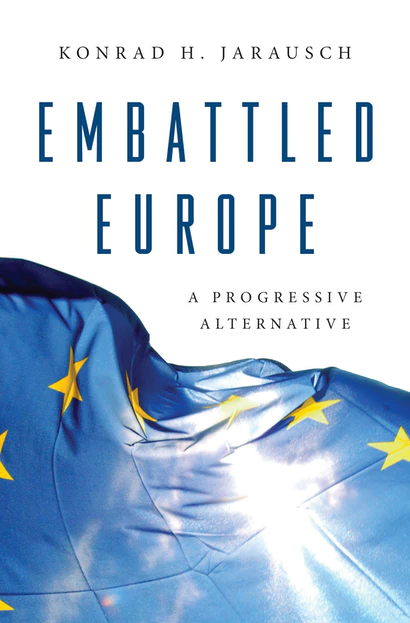
Konrad Jarausch on Realistic Progress
RevDem editor Ferenc Laczo interviewed historian Konrad H. Jarausch, Lurcy Professor of European Civilization at the University of North Carolina at Chapel Hill, about his latest book Embattled Europe: A Progressive Alternative, a rich and finely balanced portrait of contemporary Europe.
10.09.2021